
You've been staring at the same problem for days. Maybe weeks. You've made lists. You've talked it through with people you trust. You've Googled it, slept on it, and come back to it fresh. And yet here you are, still stuck.
It doesn't mean you're not smart. It doesn't mean you're not trying hard enough. It means you're probably solving the wrong version of the problem.
That's the real reason most problem-solving fails. Not lack of effort. Not lack of intelligence. The wrong starting point.

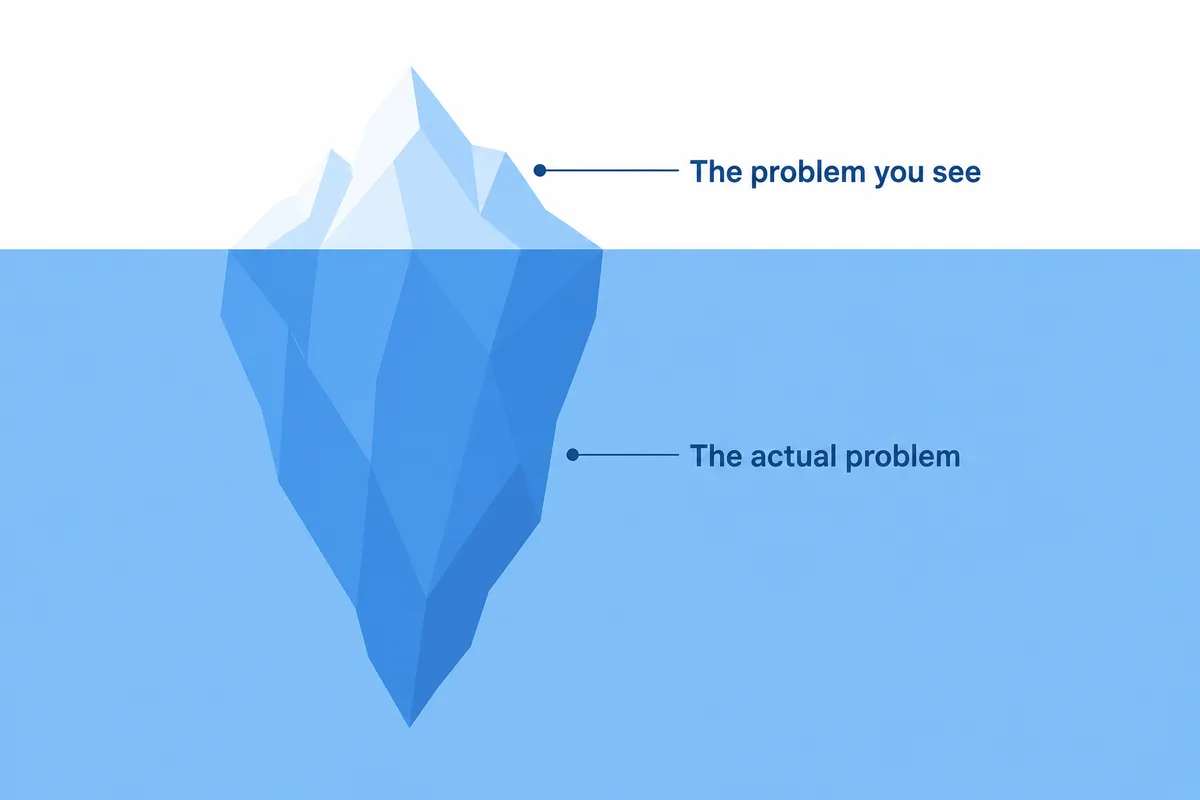
You're Solving the Problem You Can See, Not the Problem You Have
When something goes wrong, the human brain immediately reaches for the most visible explanation. The project failed because the timeline was too short. The business isn't growing because marketing isn't working. The team is underperforming because of one difficult person.
These explanations feel right. They're right there on the surface. And because they're visible, they attract all the effort.
But surface problems are almost never the real problem. They're symptoms. And when you treat a symptom, the underlying issue stays intact and finds another way to show up.
This is why solutions that should work, don't. You fix the timeline and the next project still runs late. You change the marketing and growth still stalls. You move the difficult person and the team dynamic somehow stays broken.
The fix didn't stick because it was aimed at the wrong target.
Why Smart People Fall Into This Trap
Here's the uncomfortable part. The smarter and more experienced you are, the easier it is to fall into this trap.
Experience gives you pattern recognition. You've seen similar situations before, so your brain shortcuts to a familiar answer. That's usually a good thing. But when the current situation is different in some important way you haven't noticed yet, that shortcut sends you straight to the wrong solution with complete confidence.
It feels like clarity. It's actually a blind spot.
The other thing that happens is that we unconsciously frame problems in ways that protect us. If the real problem requires admitting something uncomfortable, changing something we don't want to change, or confronting something uncertain, our brain quietly adjusts the framing so we don't have to go there.
We solve the problem we can handle instead of the problem we have.
The Framework Problem
Most problem-solving frameworks don't help with this. In fact, some of them make it worse.
Frameworks like SWOT analysis, 5 Whys, and root cause analysis are useful tools. But they all share a common assumption: that you've correctly identified the problem before you start. They help you go deeper on the problem you've already named. They don't help you question whether you've named the right problem in the first place.
So you end up with a very thorough, very structured analysis of the wrong thing.
It's like having a high-precision GPS that gives you perfect directions to the wrong destination. The tool works perfectly. You just started with the wrong address.
What Actually Works
The shift that changes everything is learning to look at your problem from angles you haven't tried yet.
Not just brainstorming more solutions to the problem as stated. Actually questioning the problem itself. Turning it around. Looking at what's not there instead of what is. Asking what would have to be true for this to not be a problem at all.
This sounds simple. It's genuinely hard to do on your own. Your brain is wired to stay inside the frame it already built. Stepping outside that frame requires deliberate effort and usually some kind of external perspective, whether that's another person, a structured process, or a tool designed to push your thinking into new territory.

The Inversion Trick
One of the most powerful reframing techniques is inversion. Instead of asking how do I solve this problem, ask what would make this problem worse or what would guarantee failure.
This flips your perspective in a way that's surprisingly hard to do naturally but very easy to do once you know the trick. And the answers often reveal the actual structure of the problem in ways that direct thinking doesn't.
If you're trying to grow a business and you ask what would guarantee we don't grow, you might notice that the answer has nothing to do with marketing. It's about retention. Or pricing. Or the product experience. Things that weren't even on your radar when you were looking at the problem head-on.
Suddenly the real problem is visible. And it's solvable.
The Indirect Path
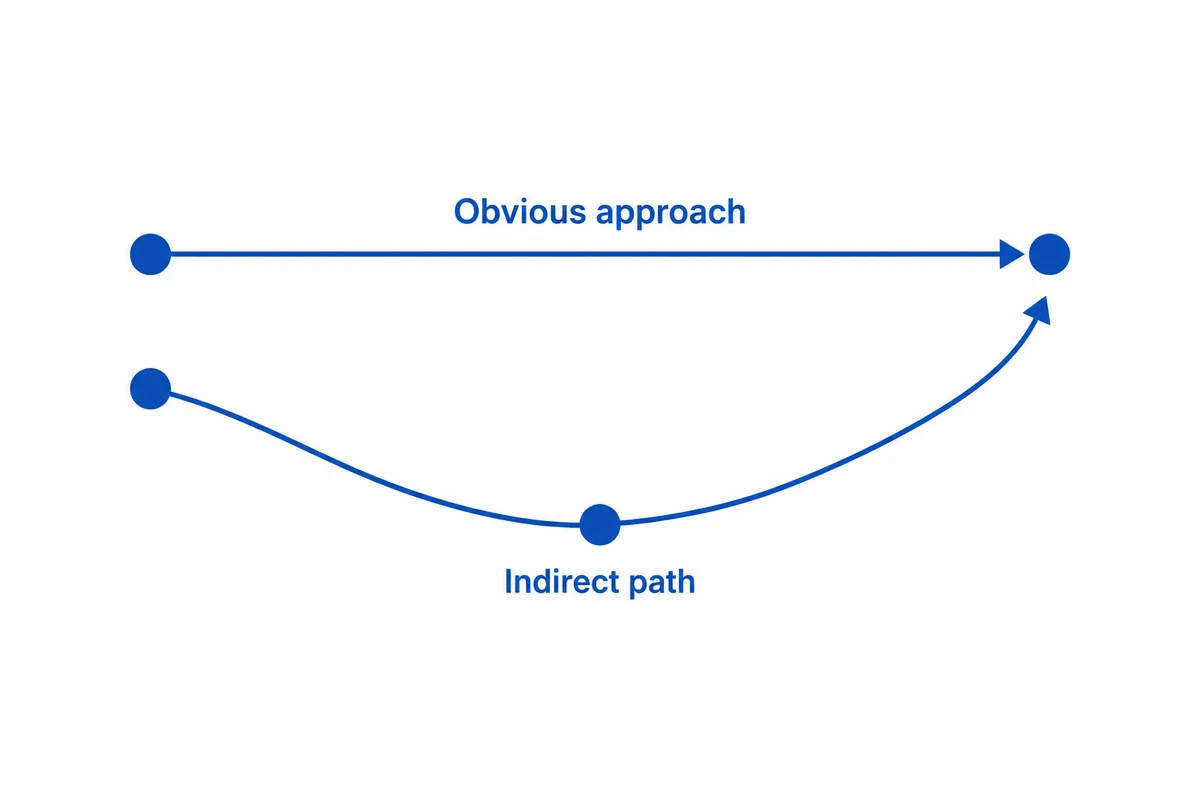
Another angle worth trying is asking whether there's an indirect route to the outcome you want.
Most of us default to direct solutions. Problem A, solution B. But sometimes the most effective path runs through something that doesn't look related at all.
A company struggling with customer churn might spend months trying to improve customer service. The indirect path might be to fix the onboarding experience three months earlier, before frustration ever builds. The outcome is the same. The path is completely different.
Training yourself to ask whether there's a less obvious way to get here opens up options that direct thinking never finds.
The Leverage Question
Not all parts of a problem are equal. Some elements, if changed, would shift everything. Others barely matter.
Getting good at finding the high-leverage point in a problem is one of the highest-value skills you can develop. It's the difference between working hard and working on the right thing.
The leverage question is this: if I could only change one thing, what would have the biggest impact on everything else? This forces you to think about the problem as a system rather than a list of things to fix.
Often the answer surprises you. The high-leverage point is rarely the most visible part of the problem. It's usually quieter and deeper.
Why This Is Hard to Do Alone
All of these approaches, inversion, indirect paths, leverage thinking, reframing the problem itself, are much harder to do in your own head than they sound on paper.
The reason is that your brain already has a model of the situation. Every time you try to think about it, you're thinking inside that model. The model filters what you notice, what feels relevant, and what solutions seem worth considering.
Breaking out of your own mental model is genuinely one of the hardest cognitive tasks there is. It's not a character flaw. It's just how minds work.
This is why talking to someone outside your situation is so valuable. They don't have your model. They see the problem fresh. They ask questions that feel obvious to them but had never occurred to you, and those questions crack things open.

The Practical Starting Point
If you're stuck on something right now, here's where to start.
Write down the problem as you currently see it. Then ask yourself three questions.
First: am I solving the symptom or the cause? Push past the first answer you get. Ask why at least three times.
Second: what am I assuming is fixed that might not actually be fixed? Most constraints we accept as real are actually negotiable if we look at them directly.
Third: what would someone who knows nothing about this situation ask me? Try to answer that question honestly.
These three questions alone will often shift your perspective enough to see something you were missing.
Tools Help When Your Own Thinking Gets Stuck
Sometimes three questions aren't enough. The problem is too complex, too emotionally loaded, or you've been inside it too long to see it clearly.
This is exactly what Solvur is built for. It takes your problem and runs it through multiple strategic lenses simultaneously, looking at it from angles that trained problem-solvers use but most people never think to apply on their own. It asks the follow-up question you hadn't thought of. It finds the path you weren't looking at.
It doesn't solve your problem for you. It helps you see it clearly enough that you can.
If you've been stuck on something, it's worth trying. Sometimes one new angle is all it takes.
The Bottom Line
The reason most problem-solving fails isn't a lack of effort or intelligence. It's looking at the right problem from the wrong angle, or looking at the wrong problem altogether.
The fix isn't to try harder with the same approach. It's to step back, question the frame, and look again from somewhere new.
That's a learnable skill. And once you have it, problems that felt impossible start to look very different.
Ready to see your problem from a new angle? Try Solvur.